<?xml version="1.0" encoding="utf-8"?><feed xmlns="http://www.w3.org/2005/Atom" ><generator uri="https://jekyllrb.com/" version="3.10.0">Jekyll</generator><link href="https://blog.david-andrzejewski.com/feed.xml" rel="self" type="application/atom+xml" /><link href="https://blog.david-andrzejewski.com/" rel="alternate" type="text/html" /><updated>2026-01-24T16:25:43+00:00</updated><id>https://blog.david-andrzejewski.com/feed.xml</id><title type="html">David A Notes</title><subtitle>YOUR OFFWORLD INVESTMENTS IN ARTIFICIAL DUMBNESS PAID $? IN DIVIDENDS</subtitle><author><name>David M. Andrzejewski</name></author><entry><title type="html">Technical communication tactics</title><link href="https://blog.david-andrzejewski.com/technical-communication-tactics.html" rel="alternate" type="text/html" title="Technical communication tactics" /><published>2026-01-18T00:00:00+00:00</published><updated>2026-01-18T00:00:00+00:00</updated><id>https://blog.david-andrzejewski.com/technical-communication-tactics</id><content type="html" xml:base="https://blog.david-andrzejewski.com/technical-communication-tactics.html"><![CDATA[<blockquote>
  <p>Con el tiempo, esos Mapas Desmesurados no satisficieron y los Colegios de Cartógrafos levantaron un Mapa del Imperio, que tenía el tamaño del Imperio y coincidía puntualmente con él. -<a href="https://borgestodoelanio.blogspot.com/2017/10/jorge-luis-borges-en-su-voz-del-rigor.html"><em>Del Rigor en la Ciencia</em></a>, Jorge Luis Borges</p>
</blockquote>

<p>In software projects with significant collaboration and coordination dimensions, many problems are ultimately <em>communication</em> problems. Diverse stakeholders can have subtly different mental models of the critical behaviors and constraints, and a wide variety of processes (eg, agile) and tools (eg, requirements and design docs) have been developed to try and help teams converge and align their thinking as quickly and easily as possible.</p>

<p>There is also another important dimension of learning, where the team must <em>discover</em> what the Real Problem and Appropriate Solution actually are, but we’ll set that aside for now and focus on the problem of <em>iterative high-fidelity consensus-building</em>. Note that here I don’t mean “consensus” on the <em>decision-making</em> but rather reaching alignment around the core facts and details, the essential characteristics of the problem and the associated space of solutions.</p>

<h2 id="maps-and-territories">Maps and territories</h2>
<p>A common tactic is to develop an intuition for some domain by considering the most extreme boundary cases. In our software project example, one (admittedly silly) way to ensure everyone has arrived at a common understanding would be for all individuals (or sub teams if you like) to:</p>
<ol>
  <li>completely build their components out</li>
  <li>try to put it all together at the end</li>
  <li>see if things line up with everyone’s expectations</li>
  <li>if necessary, go back to 1.</li>
</ol>

<p>In this methodology, the pieces are guaranteed to be highly realistic and detailed expressions of everyone’s thinking, but of course these artifacts are very expensive to produce and even two iterations of this process would not be practical.</p>

<p>At the other end, imagine a workflow where everyone builds out ridiculously low-fidelity versions (say, crayon drawings) of their pieces and then attempts to integrate and evaluate the results. This would be dramatically faster and cheaper, but the elision of any meaningful detail would limit the usefulness of the exercise.</p>

<p>Trying to split the difference, teams could build and share lower-fidelity but still meaningful artifacts like rough prototypes, API specifications, or even simple natural language descriptions. Hopefully, this compromise is able to remedy the excesses of our previous proposals, avoiding the expense of completely building out “the real thing” while still having enough realistic detail to facilitate actual learning on each iteration.</p>

<h2 id="essential-details">Essential details</h2>

<blockquote>
  <p>…abstraction is what makes precision possible. … Abstraction is really about going to a higher semantic level where we can talk in a language where we can be absolutely precise about the things that we want to be talking about. -<a href="https://corecursive.com/004-design-principles-from-functional-programming-with-runar-bjarnason/">Corecursive Podcast: Design Principles From Functional Programming With Rúnar Bjarnason</a></p>
</blockquote>

<p>Working in our “medium-fidelity” regime, how can we make the most of our effort, attention, and communication bandwidth? Possibly we could consider learning from a setting where participants must convey complex and novel ideas under difficult constraints. I am talking, of course, about <em>research papers</em>.</p>

<p>Most of my research paper-reading experience has been around machine learning (ML) papers, which can cover domain-specific problem formulations,  mathematical definitions, optimization procedures, systems-oriented implementation details, theoretical guarantees, evaluation criteria, and more. This wide range of content poses challenging trade-offs between precision and brevity, but the diversity of backgrounds in the audience limits the amount of common vocabulary or convention that authors can assume. ML papers therefore give us a nice example of a tricky problem domain for communication and, in some sense, collaboration distributed over space and time. So what tools can we make use of? Let’s walk through a handful of common tactics and specific examples.</p>
<h3 id="elevator-pitch-tweet">Elevator pitch tweet</h3>
<h4 id="qlora-efficient-finetuning-of-quantized-llms-dettmers-et-al-2023"><a href="https://arxiv.org/abs/2305.14314">QLoRA: Efficient Finetuning of Quantized LLMs (Dettmers et al 2023)</a></h4>

<p>The authors promoted their work with a <a href="https://x.com/Tim_Dettmers/status/1661379354507476994">short and simple post</a> that starts with the headline: “QLoRA: 4-bit finetuning of LLMs.” Follow-up posts begin with a handful of concise and digestible bullet points, such as “97% ChatGPT performance on 1 consumer GPU in 12 hours.” Further down the thread, the author gets into deep dive technical details and surprising quantitative results.</p>

<p>While the initial post acts as a hook or advertisement for the rest of the details, what is great is that, for some use cases, <em>one can stop right there</em> - the core idea is given in (much) fewer than 140 characters. Investing the effort into honing your proposal or idea into such a finely distilled summary can be well worth it.</p>
<h3 id="block-diagrams">Block diagrams</h3>
<h4 id="mapreduce-simplified-data-processing-on-large-clusters-dean--ghemawat-2004"><a href="https://static.googleusercontent.com/media/research.google.com/en//archive/mapreduce-osdi04.pdf">MapReduce: Simplified Data Processing on Large Clusters (Dean &amp; Ghemawat 2004)</a></h4>

<p>“A picture is worth 1000 words” - how does MapReduce work? Take a look:</p>

<p><img src="/assets/img/map-reduce.png" alt="" class="img-responsive center-image" width="80%" /></p>

<p>This diagram captures the essentials:</p>
<ul>
  <li>what are the major components?</li>
  <li>for each component: what goes in, what comes out?</li>
  <li>which components connect to each other?</li>
</ul>

<p>Importantly, it also <em>omits</em> details that would only obscure the basic idea:</p>
<ul>
  <li>how is the networking set up (routers, switches, etc)?</li>
  <li>what formats are the input / output files in?</li>
  <li>what about calculations that require multiple iterations?</li>
</ul>

<p>Even if there are details that an implementation-minded expert knows and cares about, it is possible to make an intentional decision to leave them out in order to more crisply convey the core idea.</p>
<h3 id="end-to-end-examples">End-to-end examples</h3>
<h4 id="adjusting-machine-learning-decisions-for-equal-opportunity-and-counterfactual-fairness-wang-sridhar--blei-2023"><a href="https://www.cs.columbia.edu/~blei/papers/WangSridharBlei2023.pdf">Adjusting Machine Learning Decisions for Equal Opportunity and Counterfactual Fairness (Wang, Sridhar &amp; Blei 2023)</a></h4>

<blockquote>
  <p>Consider automating the admissions process at a university… To illustrate the ideas, we will consider a simple setting. Suppose there are only two attributes for each applicant, their gender and their score on a test… The gender is a protected attribute; the test score is not.</p>
</blockquote>

<p>The system proposed in the paper is very general, but is made much clearer with a minimal concrete running example. Even if your system design could handle some very broad range of use cases, walking through one (or a handful) of <em>very specific</em> end-to-end examples can make the mechanics dramatically more comprehensible.</p>
<h3 id="mathematical-formulas">Mathematical formulas</h3>
<h4 id="attention-is-all-you-need-vaswani-et-al-2017"><a href="https://proceedings.neurips.cc/paper_files/paper/2017/file/3f5ee243547dee91fbd053c1c4a845aa-Paper.pdf">Attention Is All You Need (Vaswani et al 2017)</a></h4>

<p>When appropriately deployed, few human communication technologies can beat mathematical formulas for precision and succinctness.  Let’s see the “formula that launched $1T of capex”:</p>

<p>$\mathrm{Attention}(Q, K, V) = \mathrm{softmax}\left(\frac{Q K^\top}{\sqrt{d_k}}\right) V$</p>

<p>An important prerequisite to this guidance is the requirement to first build out the scaffolding in the form of clear supporting definitions. If we don’t know what $Q$ or <code class="language-plaintext highlighter-rouge">softmax</code> are, this is not very illuminating. Also, if the subject matter is not a natural fit for this kind of expression, trying to use it anyways can result in an awkward and confusing formulation.</p>
<h3 id="pseudocode">Pseudocode</h3>
<h4 id="stanford-cs-221-k-means-handout-chris-piech-based-on-a-handout-by-andrew-ng"><a href="https://stanford.edu/~cpiech/cs221/handouts/kmeans.html">Stanford CS 221 K Means handout (Chris Piech, based on a handout by Andrew Ng)</a></h4>
<p>In these course notes, the core procedural idea of k-means clustering is made very clear to anyone with the ability to read Python code. Like the MapReduce diagram, inessential detail can be omitted (contributing to the “pseudo” aspect) to simplify and emphasize the main concept. One nice thing on display here is the use of helper functions, as actually inlining the implementations of all the helper functions would have made the main idea less legible.</p>
<h3 id="show-me-the-code-and-results">Show me the code (and results)</h3>
<h4 id="end-to-end-object-detection-with-transformers-carion-et-al-2020"><a href="https://ai.facebook.com/research/publications/end-to-end-object-detection-with-transformers">End-to-End Object Detection with Transformers (Carion et al 2020)</a></h4>
<p>This is an example of a research paper with an <a href="https://github.com/facebookresearch/detr">associated repo</a> that provides code, <a href="https://cocodataset.org/#download">link to the dataset</a>, expected format, and specific commands for training and evaluation.</p>

<p>In general, ML/AI research has raised the bar to include self-contained code artifacts for the core approach and experimental evaluations against benchmark problems and datasets. If there is any doubt or ambiguity about <em>exactly</em> how the idea works or implementation micro-decisions were made, the code provides the ultimate judgment. In other projects, it can be useful to keep this idea of “ground truth” in mind; sometimes there is no substitute for really digging deeply into the details.</p>

<p><a href="https://arxiv.org/abs/2310.00865">Data Science at the Singularity (Donoho 2023)</a> in fact credits the adoption of “frictionless reproducibility” for driving rapid progress in the field of “Empirical Machine Learning.” Note that this doesn’t work without the available datasets and well-defined challenge problems, such as <a href="https://arxiv.org/abs/1409.0575">ImageNet Large Scale Visual Recognition Challenge (Russakovsky et al 2015)</a>.</p>

<h2 id="news-you-can-use">News you can use</h2>
<p>Turning everything into a miniature research paper is probably not a great way to communicate, but this “bag of tricks” can be useful to keep in mind when trying to quickly and effectively convey complex ideas in day-to-day work - good luck!</p>]]></content><author><name>David M. Andrzejewski</name></author><summary type="html"><![CDATA[Con el tiempo, esos Mapas Desmesurados no satisficieron y los Colegios de Cartógrafos levantaron un Mapa del Imperio, que tenía el tamaño del Imperio y coincidía puntualmente con él. -Del Rigor en la Ciencia, Jorge Luis Borges]]></summary><media:thumbnail xmlns:media="http://search.yahoo.com/mrss/" url="https://blog.david-andrzejewski.com/school.jpg" /><media:content medium="image" url="https://blog.david-andrzejewski.com/school.jpg" xmlns:media="http://search.yahoo.com/mrss/" /></entry><entry><title type="html">Hitting the Books</title><link href="https://blog.david-andrzejewski.com/hit-the-books.html" rel="alternate" type="text/html" title="Hitting the Books" /><published>2025-07-17T00:00:00+00:00</published><updated>2025-07-17T00:00:00+00:00</updated><id>https://blog.david-andrzejewski.com/hit-the-books</id><content type="html" xml:base="https://blog.david-andrzejewski.com/hit-the-books.html"><![CDATA[<p>I’ve recently(-ish) been doing some self-study using textbooks, and
I’m briefly capturing some reflections on the process here. As far as
I can tell most of the <em>actual learning</em> happens as a result of:</p>

<ol>
  <li>my own note-taking, where I re-structure or re-schema what I’m
reading into my own terms. This is an active process on multiple
levels. First, I need to do some editorial curation in terms of
what to capture, elide, or emphasize. Second, I reflect on what I’m
jotting down: does this really make sense, are claims seem fully
supported, what are the implications of this theorem, and so
on. The final artifacts (pages of notes) are a nice encapsulation
of my understanding, and I do occasionally revisit and review
these. However, I suspect that most of the value I am getting out
of the exercise comes from the process itself, where the active
engagement with the material makes the content dramatically more
“sticky” for me.</li>
  <li>doing the exercises, where applicable. Generally it seems that the
textbook authors have carefully constructed these to test and
stretch the reader’s understanding in incremental and valuable
ways. I usually choose some sampling of intermediate-difficulty
problems, as these feel like the best ROI on my time. I also work
through the inline proofs myself, although I generally don’t do
them myself from scratch. It would be more accurate to say that I
follow along very closely, working out each individual step and
convincing myself that it is correct, at roughly the level of a
code review. On occasion, I will try to fill in the blanks, either
guessing ahead at what the next step should be, or looking ahead at
a later step and trying to fill in the intermediate steps
myself. This is less challenging than trying to develop a proof
entirely on my own, but involves more attention and effort than
simply reading it.</li>
</ol>

<p>I would be remiss not to briefly mention my significant usage of
ChatGPT in this process. This topic merits its own entire writeup, but
I use the tool as a kind of “Teaching Assistant” on problems where I
get stuck, proof steps that don’t make sense, stress-testing
intuitions or connections I am developing, and other general questions
that come up. An example of this was when I was doing some exercises
in Quantum Computing and I kept noticing that certain matrices had the
property $AB=-BA$, so I asked about this and learned the proper name
for the property
(<a href="https://en.wikipedia.org/wiki/Anticommutative_property"><em>anticommutative</em></a>)
and its connection to the <a href="https://en.wikipedia.org/wiki/Pauli_matrices">Pauli
matrices</a>. For
particularly interesting or tricky ideas, I’ve also begun vibe-coding
simple simulations or <a href="https://www.david-andrzejewski.com/fun/quantum.html">short animated visualizations of
concepts</a> using
the <a href="https://github.com/ManimCommunity/manim/">manim</a> ”community
edition” library. As before, the process of developing one of these
scripts is itself a productive exercise in terms of building
intuitions. So for me, somewhat surprisingly, ChatGPT (or similar)
ends up being a very nice <em>complementary</em> resource for self-study
alongside traditional textbooks.</p>

<p>That all being said, I should also mention the time I mis-transcribed
some of the instructor’s handwriting on the whiteboard from the
<a href="https://www.coursera.org/learn/introduction-to-quantum-information">Quantum Information
Coursera</a>
and mistakenly asked ChatGPT about the “CHZ quantum state” (which does
not exist) instead of the “GHZ state” the instructor was actually
talking about. Rather than asking me if I had intended to ask about
the <a href="https://en.wikipedia.org/wiki/Greenberger%E2%80%93Horne%E2%80%93Zeilinger_state">Greenberger–Horne–Zeilinger (GHZ)
state</a>,
ChatGPT confidently hallucinated a plausible sounding explanation
centered on 3 quantum researchers (who did indeed exist) with the
appropriate initials “CHZ” along with a related-ish paper one of them
had written (see below). The fake state and its supposed properties
were even somewhat similar to the real one! I found this failure mode
to be pretty incredible. This experience underscored the importance of
using these tools as a supplement to, but not substitute for, standard
textbooks and other canonical resources.</p>

<blockquote>
  <p>The CHZ quantum state is named after its inventors: Cabello, Hardy,
and Zukowski. The CHZ state is a three-qubit entangled state that
has some interesting properties that make it useful for various
quantum information processing tasks, such as quantum teleportation
and quantum key distribution. The state was introduced in a 1999
paper by Antonio Cabello, Lucien Hardy, and Marek Zukowski titled
“Bell’s Theorem for General N-Qubit States and Quantum Mechanics of
Classical-Like States”.</p>
</blockquote>]]></content><author><name>David M. Andrzejewski</name></author><summary type="html"><![CDATA[I’ve recently(-ish) been doing some self-study using textbooks, and I’m briefly capturing some reflections on the process here. As far as I can tell most of the actual learning happens as a result of:]]></summary><media:thumbnail xmlns:media="http://search.yahoo.com/mrss/" url="https://blog.david-andrzejewski.com/books.jpg" /><media:content medium="image" url="https://blog.david-andrzejewski.com/books.jpg" xmlns:media="http://search.yahoo.com/mrss/" /></entry><entry><title type="html">Conway and Coase on Collaboration in Software</title><link href="https://blog.david-andrzejewski.com/conway-coase.html" rel="alternate" type="text/html" title="Conway and Coase on Collaboration in Software" /><published>2024-03-17T00:00:00+00:00</published><updated>2024-03-17T00:00:00+00:00</updated><id>https://blog.david-andrzejewski.com/conway-coase</id><content type="html" xml:base="https://blog.david-andrzejewski.com/conway-coase.html"><![CDATA[<p>Building software is a team sport, but who’s on your team? The answer may surprise you!</p>

<h2 id="conway--coase">Conway &amp; Coase</h2>

<p><a href="https://martinfowler.com/bliki/ConwaysLaw.html">Conway’s Law</a> states that the structure of a large software project will inevitably come to resemble the organizational structure of the teams who build it. Colloquially, you are destined to “ship your org chart.” A critical insight here is the immense influence of human coordination mechanics on how software is built.</p>

<p>Loosely speaking, <a href="https://onlinelibrary.wiley.com/doi/full/10.1111/j.1468-0335.1937.tb00002.x">Coase’s Theory of the Firm</a> answers the question: if markets are so effective a means of coordinating activity, why do we have sizable firms that internally use non-market information aggregation and decision-making processes? Oversimplifying, the answer is <em>transaction costs</em>: compared with simple command-and-control authority (eg, your boss tells you to do something), market transactions may entail additional friction in the form of price discovery, negotiation, contracts and assurances, and other coordination.</p>

<p>However, as technology and processes evolve, the “frontier” of which needs can be best met internally (via in-house capabilities) or externally (via the market) <em>can shift</em>. For example, standardization of a given physical input (like screws, or integrated circuits) can facilitate the sourcing of these components from third-party suppliers in the marketplace by decreasing the transaction costs.</p>

<h2 id="the-cloud--saas">The Cloud &amp; SaaS</h2>

<p>We might consider the evolution of the software industry through this lens. Open-source or commercial libraries or systems such as databases are analogous to physical inputs to a manufacturing process and have long been a part of the “software supply chain.” More recently, cloud computing has exploded in popularity and Software-as-a-Service (SaaS) vendors and use cases have rapidly proliferated.</p>

<p>For many SaaS vendors, the explicit value proposition for their customers is that acquiring the associated functionality (when not deemed essential to competitive differentiation) from the vendor can be a more attractive proposition than expensive and risky custom software development. Why should your business build your own payroll, authentication, or customer support systems? Ideally, this is a classic story of gains from specialization and trade: the vast majority of businesses are much better off outsourcing these functionalities to a constellation of external vendors who are each manically focused on their respective domains.</p>

<p>Taken together, Conway and Coase give us some interesting tools with which to think about modern software. In some sense, <em>using AWS is a specially structured and intermediated collaboration with the Amazon teams who build and operate those services</em>. If you build your application on AWS, certain architectural design patterns fit more naturally with the assortment of services offered by AWS, and in fact this is explicitly captured in in their various <a href="https://aws.amazon.com/architecture/">best practice architecture guidance docs</a>. It’s Conway’s Law in action, but you’re shipping the AWS service offering catalog (ie, <em>their</em> org chart)! In a further fun twist, many of the aforementioned SaaS vendors are providing some coherent bundle of functionality and business value by building their services <em>on top of AWS</em>.</p>

<h2 id="the-past-and-future-of-software-and-coordination">The past and future of software and coordination</h2>

<p>One potential perspective on this dynamic is that recent technical and organizational changes have lowered transaction costs and shifted the “build-vs-buy” boundary between problems best tackled internally versus those where it makes more sense to shop for solutions in the marketplace. Software engineers have excellent reasons for building their apps by cleverly combining various vendor APIs and cloud services, but perhaps don’t often enough have the opportunity to step back and appreciate the deeper nature of the implicit globe-spanning inter-firm collaboration networks in which they are participating. While these ideas can be useful for understanding the recent history of software, it is an interesting open question whether they can help us navigate its near future as well.</p>

<blockquote>
  <p>Practical men, who believe themselves to be quite exempt from any intellectual influence, are usually the slaves of some defunct economist. -<a href="https://en.wikiquote.org/wiki/John_Maynard_Keynes#The_General_Theory_of_Employment,_Interest_and_Money_(1936)">John Maynard Keynes</a></p>
</blockquote>]]></content><author><name>David M. Andrzejewski</name></author><summary type="html"><![CDATA[Building software is a team sport, but who’s on your team? The answer may surprise you!]]></summary><media:thumbnail xmlns:media="http://search.yahoo.com/mrss/" url="https://blog.david-andrzejewski.com/basketball.jpg" /><media:content medium="image" url="https://blog.david-andrzejewski.com/basketball.jpg" xmlns:media="http://search.yahoo.com/mrss/" /></entry><entry><title type="html">Engineering as Shadow Price Discovery</title><link href="https://blog.david-andrzejewski.com/engineering-price-discovery.html" rel="alternate" type="text/html" title="Engineering as Shadow Price Discovery" /><published>2022-10-30T00:00:00+00:00</published><updated>2022-10-30T00:00:00+00:00</updated><id>https://blog.david-andrzejewski.com/engineering-price-discovery</id><content type="html" xml:base="https://blog.david-andrzejewski.com/engineering-price-discovery.html"><![CDATA[<h2 id="engineering-solving-problems-under-constraints">Engineering: solving problems under constraints</h2>

<p>Many engineering problems have the general form of trying to achieve
some desired capabilities at minimum cost, or alternatively trying to
design the best performing system within a certain price point. For
purposes of a concrete example, say we are designing one of those
rolling delivery robots like <a href="https://www.youtube.com/watch?v=cZTCmx6N7Xc">these ones I used to see rolling around
Redwood City,
California</a>. To simplify,
say that we need to achieve some range target while keeping the size
below a certain city-mandated limit, and we’d like to have as much cargo capacity as
possible while minimizing costs.</p>

<p>Tackling this problem, we realize that a cheaper battery can get us
the desired range, but takes up more room that could otherwise be used
for cargo capacity. More cargo capacity means more weight which
requires more battery power for the same range. Everything costs
money. How to decide what to do?</p>

<p><img src="/assets/img/delivery-robot-gold.png" alt="Robot money" class="img-responsive center-image" /></p>

<h3 id="there-are-always-trade-offs--no-free-lunch">There are always trade-offs / No Free Lunch</h3>

<p>Besides being something nice to say in a meeting if you have nothing
else to add to the discussion, what does it mean to say that “there
are always trade-offs”?  Consider the case where this is not true: ie,
you can potentially increase something good (performance, reliability,
capacity) or decrease something bad (cost, pollution, delays) in the
design without paying any price along other dimensions. This is
sometimes known as a “free lunch”, and of course you would take
it. Now, having maxed out on all available free lunches, you are now
at some point in the constraint space where you can no longer get
something for nothing. Once again, there are trade-offs! This is why
there are always trade-offs: if there were free lunches to be had you
would have already taken them, so here you are facing trade-offs.</p>

<h2 id="constrained-optimization">Constrained Optimization</h2>

<p><a href="https://en.wikipedia.org/wiki/Constrained_optimization">Constrained
Optimization</a>
gives us a formal way to define problems where we want to maximize (or
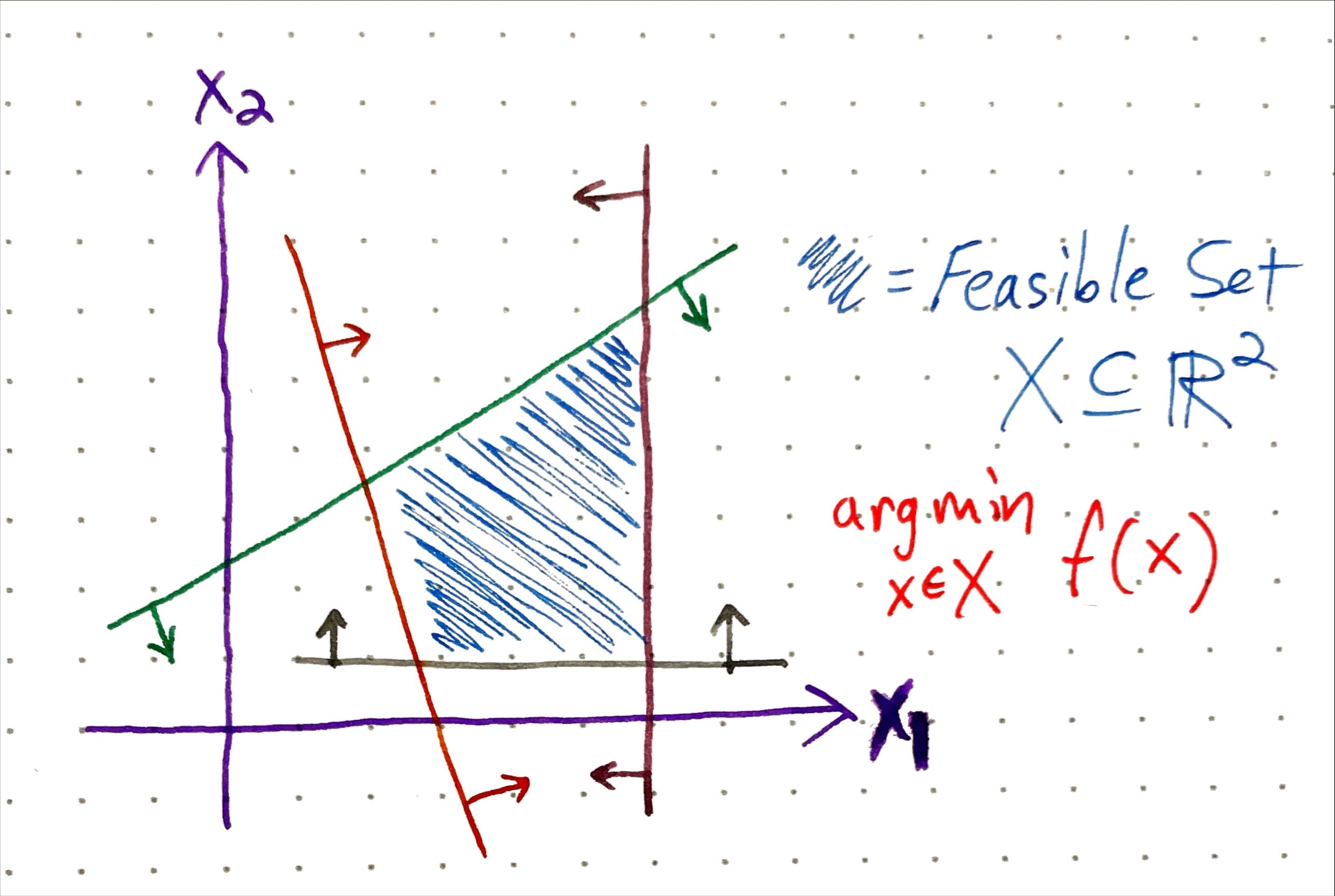
minimize) some mathematical function \(f(x)\) (known as the <em>objective
function</em>) in terms of variables \(x\) which are subject to some
constraints (either equality \(g(x)=c\) or inequality \(h(x) \leq d\))
that define the <em>feasible set</em> of possible solutions. This field and
its associated literature are vast and fascinating, and the amount of
real-world activity influenced or controlled by the solutions of these
optimizations is mind-boggling.  In some sense, the tools of
optimization can give us a rigorous way to navigate trade-offs.</p>

<p><img src="/assets/img/constrained-opt.jpg" alt="Constrained optimization" class="img-responsive center-image" /></p>

<p>We are just employing these concepts in an intuitive hand-wavy way
here and we won’t be digging too deeply into actual equations. Going
back to our delivery robot, imagine that we can drop in some specific
objective function and parameters to perfectly capture the constraints
and optimization goal described above. In this scenario, we can then
just drop all this into some solver software and magically get the
quantitative parameters that define the optimal or ideal design -
hooray!</p>

<h3 id="shadow-prices">Shadow Prices</h3>

<p>Having designed the perfect cargo robot for your exact circumstances,
you are enjoying a coffee when your <a href="https://www.hbo.com/silicon-valley/cast-and-crew/jared-dunn">Product
Manager</a>
(PM) bursts into the room and informs you that your employer has
successfully lobbied to have local regulations changed to increase the
maximum size of cargo robots by 3.7%! What does it mean for your
design?</p>

<p>Before tackling this question, we must circle back to the original
objective function definition. Recall that we want “as much cargo
capacity as possible while also minimizing costs.” Unfortunately this
is not, strictly speaking, a coherent objective function as we’ve no
way to weigh a gain in cargo space against a decrease in
costs. Instead, we have to define some “profitability” objective to be
maximized that goes up with cargo space and down with manufacturing
costs.  In this definition, our stakeholders (say, the aforementioned
PM) must have devised a valuation model for cargo space that
standardizes its unit of measure to be directly comparable to
manufacturing costs - eg, $10 per cubic meter of storage.</p>

<p><a href="https://en.wikipedia.org/wiki/Shadow_price"><em>Shadow Prices</em></a> extend
this standardization to <em>all of the other variables and
constraints</em>. At a given optimal solution, the shadow price for a
given constraint tell us how much “better” we could do on the
objective function (eg, profitability) if this constraint were <em>very
slightly</em> (ie, <em>infinitesimaly</em>) relaxed. This means that, given the
shadow price of the “size” constraint at our solution, we can now
calculate the the approximate ROI of our company lobbyist who
negotiated that 3.7% increase - great job!</p>

<h2 id="shadow-price-discovery">Shadow Price discovery</h2>

<p>In our cargo robot example, things worked out very nicely that the
objective function was a relatively unambiguous target like “money”,
and also that the PM was somehow able to devise a closed-form cash
valuation model for cubic meters of cargo space. In real-world
projects thing <em>may not</em> work out so cleanly. In fact, for an internal
software engineering project, it is likely that there is not a
well-defined objective function in the exact same sense as in our toy
robot example. Instead, we may have a “multi-dimensional” objective
with unclear weightings among the desired properties or capabilities:</p>

<ul>
  <li>speed of delivery: when can we have it by?</li>
  <li>maintainability or extensibility of the code</li>
  <li>cost (in AWS bills) to operate</li>
  <li>reliability (uptime) of the component</li>
  <li>various “nice-to-have” features or capabilities</li>
</ul>

<p>We are now far afield of the well-defined world of Constrained
Optimization, but perhaps we can lean on some of the intuitions we
developed? Unfortunately, it may be incredibly difficult or even
impossible to come up with sensible weightings between these
properties. How much uptime are we willing to pay in order to get the
component 1 sprint earlier? What is the cash value of refactoring the
code to allow for easier extension in the future? Your stakeholders
are not going to grind out an \(N^2\) matrix of conversions weights
between the various dimensions. How can we discover the appropriate
shadow prices or exchange rates among the different properties of our
solutions in order to choose the appropriate trade-offs?</p>

<h3 id="pricing-with-assortments">Pricing with assortments</h3>

<p><a href="https://www.harrisonmetal.com/">Harrison Metal</a> has some nice short
videos explaining various business-related concepts. Several of them
explicitly target pricing, and in particular one of them covers
the idea of <em>assortments</em>.</p>

<iframe title="vimeo-player" src="https://player.vimeo.com/video/305394766?h=df68c41434" width="640" height="360" frameborder="0" allowfullscreen="">
</iframe>

<p>The video describes how <em>vertical</em> (good, better, best) and
<em>horizontal</em> (different in kind) product assortments (along with
optional “add-ons”) can be used to probe the marketplace and capture
demand (more details in
<a href="https://www.slideshare.net/heavybit/heavybit-presents-harrison-metals-michael-dearing-on-pricing">slides</a>). What
I find particularly interesting here is pricing as <em>discovery</em>: the
variation supplied by the assortments “explores” the local
neighborhood of latent consumer demand and reveals valuable
information about who is willing to pay how much for what.</p>

<p>Now we come to an interesting idea: while stakeholders may not be
willing or even able to explicitly articulate an \(N \times N\)
exchange rate matrix among wildly varying (and potentially
discontinuous or lumpy) trade-offs in a design or plan, they are more
likely to be able to choose or rank alternatives among a finite
assortment of candidate proposals that vary along the relevant
dimensions, thereby <em>implicitly</em> expressing some weightings among the
crucial trade-offs.</p>

<p>Returning to our cargo robot, let’s pretend we do not have all of the
nice equations and parameters we had previously assumed. Instead, we
can propose three alternatives to the PM:</p>

<ol>
  <li>“econo-bot” that goes all-out to minimize cost but has less cargo space</li>
  <li>“deluxe” design that has maximum cargo space, but at greater cost</li>
  <li>some medium tradeoff that interpolates between 1. and 2.</li>
</ol>

<p>Based on the feedback we get among these proposals, we gain some idea
where the PM (our internal customer) believes the “sweet spot” to be
is in terms of trading off cost and cargo space - hooray again!</p>

<h2 id="back-to-reality">Back to reality</h2>

<p>Let’s try to fit this hypothetical scenario into some coherent
framework of problem-solving in engineering. We can define
“inner-loop” engineering as finding the best (or good enough) solution
given a very nicely defined problem in terms of the goal and
constraints. This is often no simple business, for “nature cannot be
fooled”<sup id="fnref:1" role="doc-noteref"><a href="#fn:1" class="footnote" rel="footnote">1</a></sup> as they say. But (certainly in software, probably
everywhere) even this challenge is often embedded in an “outer-loop”
problem of identifying and carefully defining the appropriate goal(s)
and constraints in the first place. Given that this outer-loop defines
the boundary between the “pure” technical solution and the messy human
world, it is often a complex affair that, like pricing, can be more
art than science. This is often where the trade-offs get traded-off,
and hopefully these ideas from constrained optimization and pricing
can help provide a useful conceptual toolkit for navigating these
situations.</p>

<p>Finally some caveat: in a <a href="http://blog.david-andrzejewski.com/proddev-graph.html">previous
post</a> I
described a mental model of product development sequencing based on
Prize-Collecting Steiner Trees (PCST), a famous combinatorial
optimization problem in theoretical computer science. I thought it was
a useful conceptual framework, but I also cautioned against trying to
<em>literally</em> encode your problems in that way. Likewise, here I would
not recommend actually trying to infer shadow prices or compute the
<a href="https://www.investopedia.com/terms/n/npv.asp">NPV</a> of a given bugfix,
but it might be useful keep these tools and ideas in mind when trying
to navigate tricky trade-offs among difficult-to-compare dimensions,
and consider how one might implicitly elicit relative valuation
information from stakeholders and/or domain experts via the
presentation of carefully constructed alternatives.</p>

<div class="footnotes" role="doc-endnotes">
  <ol>
    <li id="fn:1" role="doc-endnote">
      <p>Here “they” refers to <a href="https://en.wikiquote.org/wiki/Richard_Feynman#Rogers_Commission_Report_(1986)">Richard Feynman in the Presidential Commission report on the <em>Challenger</em> Space Shuttle disaster</a>. <a href="#fnref:1" class="reversefootnote" role="doc-backlink">&#8617;</a></p>
    </li>
  </ol>
</div>]]></content><author><name>David M. Andrzejewski</name></author><summary type="html"><![CDATA[Engineering: solving problems under constraints]]></summary><media:thumbnail xmlns:media="http://search.yahoo.com/mrss/" url="https://blog.david-andrzejewski.com/shadowdog.jpg" /><media:content medium="image" url="https://blog.david-andrzejewski.com/shadowdog.jpg" xmlns:media="http://search.yahoo.com/mrss/" /></entry><entry><title type="html">Software problems</title><link href="https://blog.david-andrzejewski.com/problem-types.html" rel="alternate" type="text/html" title="Software problems" /><published>2022-09-06T00:00:00+00:00</published><updated>2022-09-06T00:00:00+00:00</updated><id>https://blog.david-andrzejewski.com/problem-types</id><content type="html" xml:base="https://blog.david-andrzejewski.com/problem-types.html"><![CDATA[<h1 id="what-do-you-do-with-a-problem-like-software">What do you do with a problem like software?</h1>

<p>Everyone in technology loves solving problems, you can just read their
cover letters and LinkedIn bios where they say so. But what are
“problems” in the context of software, exactly?</p>

<p>What follows below is a crude and idiosyncratic categorization of some
different problem flavors one might encounter in software
development. If this line of inquiry sounds intriguing, I would highly
recommend reading the classic essay <a href="http://worrydream.com/refs/Brooks-NoSilverBullet.pdf"><em>No Silver Bullet–Essence and
Accident in Software
Engineering</em></a> by
Frederick P. Brooks, Jr.</p>

<h2 id="code-problems">Code Problems</h2>

<p>You have an <code class="language-plaintext highlighter-rouge">accountId</code> provided as an argument to a method you’re
working in, but in order to make a required API call you actually need
a <code class="language-plaintext highlighter-rouge">customerId</code>. There is another microservice that can perform the
necessary translation, but the class you’re working in doesn’t have a
handle to it in scope. You will need to ensure a valid handle is
available to your class at construction-time. However, this service is
not currently used in the particular binary you’re working on, so you
need to familiarize yourself with the mechanics of the underlying
service discovery and runtime dependency injection to wire it all
up. Also you now need some additional mocking or stubbing for
automated testing of your method to avoid relying on external
services. Finally, after all of this you are able to
<code class="language-plaintext highlighter-rouge">getAccountDetails()</code>, and it is a big hit at the biweekly sprint
review.</p>

<p>The preceding stylized fiction is an example of what we could call
<em>Code Problems</em>: difficulties encountered in achieving our goals that
are largely artifacts of the organization and structure of the code
itself. You’re not up against any fundamental laws of nature here,
it’s just that, as-is, the code doesn’t currently do what you want and
you’ll need to re-arrange a few things to remedy that.</p>

<h3 id="what-to-do-about-code-problems">What to do about Code Problems?</h3>

<p>Ask this question to 2 software engineers and get 3 answers. Many
“best (?) practices” can be interpreted as attempting to minimize Code
Problems, such as Test Driven Development (TDD), static type systems,
pair programming, Functional Programming (FP), design/code reviews,
and so on. Refactoring can help make code easier to work with,
but is also likely subject to diminishing returns.</p>

<p>It isn’t obvious (to me) if there exist any conclusive answers or
one-size-fits-all fixes. Both <a href="https://danluu.com/empirical-pl/">Dan
Luu</a> and <a href="https://twitter.com/hillelogram/status/1119709859979714560?s=20&amp;t=Akmo-0GWe-DUHHIsuVYuGQ">Hillel
Wayne</a>
have conducted interesting surveys of empirical software engineering
research. See for yourself, but the results are generally mixed.</p>

<p>One other thought is that the sums of money at stake in software
development are vast. If there were $100 bills of “free lunch”
productivity improvements lying on the ground, wouldn’t someone have
already picked them up? Of course there would never be any forward
progress on anything if people took this line of thinking too
seriously, but it would seem surprising for there to be massive
obvious wins hiding in plain sight in a such a fast-moving and
competitive industry.</p>

<h2 id="physics-problems">Physics Problems</h2>

<blockquote>
  <p>As a <em>business analyst</em>, I want to <em>query unlimited amounts of data
instantly and for free</em>, so that I can <em>answer any arbitrary question
that pops into my head</em>.</p>
</blockquote>

<p>Cloud-related advertising you might see at the airport
notwithstanding, both the data and calculations required by the
aforementioned use case are, at present, regrettably carried out by
physical storage and compute devices, with all of their attendant
costs and limitations.</p>

<p>It may be a bit obvious or simplistic to put it this way, but this
physical reality means that</p>

<ul>
  <li>data (ie, actual 1’s &amp; 0’s) has to be <strong>physically</strong> moved to some compute device: this includes networking, memory to cache, and beyond</li>
  <li>some compute device (CPU, GPU, TPU, or Quantum) has to perform the desired Beta reductions, run the Turing machine, etc</li>
</ul>

<p>These (ultimately) physics-imposed constraints (of current
technologies) can therefore, in some sense, be described as ‌<em>Physics
Problems</em>.</p>

<h3 id="what-to-do-about-physics-problems">What to do about Physics Problems?</h3>

<p>For reasons that are probably fascinating in their own right, Computer
Science education seems to pay a great deal of attention to this
topic. Let’s define Computer Science Cleverness™ as the study of how
to eke out a bit (or a lot) more “bang for the buck” by organizing or
implementing our systems differently. This could include things like
caching tricks, improved algorithms, well-suited architectural
choices, or various micro-optimizations up and down the stack.</p>

<p>Armed with our requirements and Computer Science Cleverness™, we then
have (at least) three possible ways to deal with Physics Problems:</p>

<ol>
  <li>Balancing the tradeoffs between desired scale and performance and the costs and capabilities of available resources - on some level this may mean either spending more money or compromising on performance</li>
  <li>Using Computer Science Cleverness™</li>
  <li>Wait a bit for Applied Physicists and Electrical Engineers to somehow bail you out with their own brand of cleverness</li>
</ol>

<p>Given the Net Present Value (NPV) of a delivering software solution
today versus waiting for Physicists and EE’s to invent solutions to
your problems, teams tend to opt for some mixture of 1 and 2 in
practice.</p>

<h2 id="reality-problems">Reality Problems</h2>

<blockquote>
  <p>If people do not believe that mathematics is simple, it is only
because they do not realize how complicated life is. -<a href="https://en.wikiquote.org/wiki/John_von_Neumann#Quotes">John von
Neumann</a></p>
</blockquote>

<p>On this topic, I would highly advise checking out <a href="https://buttondown.email/hillelwayne/archive/data-and-reality-2nd-edition/">Hillel Wayne’s
recommendation</a>
of <em>Data and Reality</em>. In the very first chapter of that book,
seemingly trivial everyday notions (“what is a thing”) are thoroughly
inspected, and quick or easy answers are mercilessly ripped to shreds.
What is so difficult about encoding “common sense” in software? At
least part of the issue is that the dumb precision of code
necessitates explicit reckoning with a combinatorial explosion of
subtleties that, in everyday life, can (usually) be successfully
navigated well enough by an embodied human intelligence capable of
combining contextual cues with prior knowledge. This gap between human
day-to-day reasoning capabilities and the effort required to codify
“correct” behavior in software is an endless source of challenges and
bugs.</p>

<p>For another perspective, talk with anyone who has ever worked on
medical or governmental software. The dizzying complexity of the
target bureaucratic system cannot help but be reflected in any
software designed to interact with it. These concerns constitute
<em>Reality Problems</em>, and these challenges are more or less irreducible,
inherent to the real-world objectives of your software development
endeavors.</p>

<h3 id="what-to-do-about-reality-problems">What to do about Reality Problems?</h3>

<p>Can we find an easier reality? Here it may be beneficial to widen the
scope of your solution space to include the context in which your
software will be used. If 0.001% of cases require escalation to some
human judgment, maybe that’s ok, especially if excluding those cases
from the scope of requirements for the software may make things 1000x
easier.</p>

<p>Zachary Tellman’s fascinating <a href="http://blog.david-andrzejewski.com/elements-of-clojure.html"><em>Elements of
Clojure</em></a>
articulates this nicely. Paraphrasing an idea that I found
particularly resonant from that book, we could say that what is
commonly meant by “over-engineered” is that a system correctly handles
a <em>broader range of inputs or operating conditions</em> than is necessary
or intended, whereas conversely an “under-engineered” system exhibits
degraded or undesirable behaviors in some contexts in which we <em>do</em>
wish it to work properly. Distinguishing between the two, especially
in collaborative work, therefore requires carefully establishing a
common understanding of the target environments and use cases.</p>

<h2 id="the-actual-problem">The Actual Problem</h2>

<p>Setting aside code organization, performance/resource constraints, and
the mind-boggling complexity of the real world, there is still the
<em>actual original problem</em> you are trying to solve, eg enabling the
user to buy a widget from their phone. Assuming the problem itself is
indeed the right problem (a major undertaking on its own), how can we
achieve the desired goals?</p>

<h3 id="what-to-do-about-the-actual-problem">What to do about The Actual Problem?</h3>

<p>A particularly memorable Computer Science course I had the opportunity
to take was <a href="https://pages.cs.wisc.edu/~shuchi/courses/880-S07/">Special Topics Seminar in Approximation
Algorithms</a>.
Besides the fascinating content and expert instructor, part of what
made it interesting was that the other students in the class were
deeper specialists in CS Theory than I had typically encountered. I
was struck by the ease and rapidity with which, upon seeing
essentially any algorithmic problem, my classmates would pause like
the Mentat in Denis Villenueve’s <em>Dune</em> for 2 seconds before
proclaiming something like “reduces to Hamiltonian Cycle.”<sup id="fnref:1" role="doc-noteref"><a href="#fn:1" class="footnote" rel="footnote">1</a></sup></p>

<p>Mapping new situations to a “vocabulary” of known patterns is a
powerful technique that seems to recur across domains<sup id="fnref:2" role="doc-noteref"><a href="#fn:2" class="footnote" rel="footnote">2</a></sup>, and it is
not clear why software should be any different.  To what extent is
your specific task a completely unique snowflake? Accepting that even
highly innovative systems contain many “commodity” problems, much of
the work becomes deconstructing your situation into its atomic pieces,
mapping them to known solutions, modifying or adapting them to your
specific circumstances where necessary, and appropriately combining
them to yield the desired result.</p>

<p>This is not to say one can simply master this vocabulary and
relax. Rapid evolution in hardware, infrastructure, ecosystems, and
tooling mean that yesterday’s solutions may not map perfectly to
today’s problems. A solid understanding of the strengths, weaknesses,
and nuances of different techniques is critical to applying them
intelligently in new situations.</p>

<h2 id="meta-problem-problem-management">Meta-problem: problem management</h2>

<p>Which problems are the most important? As the classic senior engineer
maxim goes: “it depends”. In any given context, it becomes a
meta-problem to identify, categorize, and assess the severity of the
various problems, as well as to understand the <em>relationships</em> among
them. For example, code that is highly optimized for performance (to
solve <em>Physics Problems</em>) may be tricky to later refactor or extend,
creating <em>Code Problems</em> for future engineers (possibly including your
future self). Navigating this dynamic portfolio of interrelated
problems is arguably a significant piece of what effective software
engineers get paid to do.</p>

<p>Furthermore, this discussion has focused primarily on problems
associated with <strong>the code itself</strong>. Many of the thorniest challenges
occur at a remove from the technical details, having to do with
concerns at the “human level of the stack” such as coordination,
communication, and alignment. These deserve an altogether separate
discussion.</p>

<div class="footnotes" role="doc-endnotes">
  <ol>
    <li id="fn:1" role="doc-endnote">
      <p>Fun example: given a collection of key-value “documents”, what is the minimum set of keys required for each docoument to be uniquely identified? <a href="https://www.sumologic.com/blog/organizing-data-legends/">Why Decluttering Complex Data in Legends is Hard</a> <a href="#fnref:1" class="reversefootnote" role="doc-backlink">&#8617;</a></p>
    </li>
    <li id="fn:2" role="doc-endnote">
      <p><a href="https://www.wired.com/2010/11/the-cognitive-cost-of-expertise/">The Cognitive Cost Of Expertise</a>, <em>WIRED</em>. <a href="#fnref:2" class="reversefootnote" role="doc-backlink">&#8617;</a></p>
    </li>
  </ol>
</div>]]></content><author><name>David M. Andrzejewski</name></author><summary type="html"><![CDATA[What do you do with a problem like software?]]></summary><media:thumbnail xmlns:media="http://search.yahoo.com/mrss/" url="https://blog.david-andrzejewski.com/4thAndKing.jpg" /><media:content medium="image" url="https://blog.david-andrzejewski.com/4thAndKing.jpg" xmlns:media="http://search.yahoo.com/mrss/" /></entry><entry><title type="html">Encoder: Elements of Clojure by Zachary Tellman</title><link href="https://blog.david-andrzejewski.com/elements-of-clojure.html" rel="alternate" type="text/html" title="Encoder: Elements of Clojure by Zachary Tellman" /><published>2022-08-20T00:00:00+00:00</published><updated>2022-08-20T00:00:00+00:00</updated><id>https://blog.david-andrzejewski.com/elements-of-clojure</id><content type="html" xml:base="https://blog.david-andrzejewski.com/elements-of-clojure.html"><![CDATA[<blockquote>
  <p><em>Encoder:</em> experimenting with posting summaries or highlights of my
(often quite) rough notes on books or papers I’ve read.</p>
</blockquote>

<h2 id="elements-of-clojure-by-zachary-tellman"><a href="https://elementsofclojure.com/">Elements of Clojure by Zachary Tellman</a></h2>

<blockquote class="twitter-tweet"><p lang="en" dir="ltr">Names are not the only means of creating indirection, but they are the most common. The act of writing software is the act of naming, repeated over and over again.</p>&mdash; Elements of Clojure (@elementsofclj) <a href="https://twitter.com/elementsofclj/status/1071086965913735173?ref_src=twsrc%5Etfw">December 7, 2018</a></blockquote>
<script async="" src="https://platform.twitter.com/widgets.js" charset="utf-8"></script>

<p>In the earlier days of the “big data” buzzword, it seemed that perhaps
data processing and analysis could sensibly be done using the JVM due
to its rich libraries, mature tooling, and optimized
performance. However, Java seemed a bit clunky and verbose for this
purpose, opening the door for non-Java languages that targeted the
JVM, probably most notably <a href="https://spark.apache.org/">Scala</a> (which
<a href="https://spark.apache.org/">Spark</a> is written in) but also including a
Lisp dialect called <a href="https://clojure.org/">Clojure</a>. At some point, I
did some minor experimentation with using Clojure for data science,
and at any rate I found writing a bit of non-trivial code in a Lisp to
be an educational experience.</p>

<p><a href="https://elementsofclojure.com/">Elements of Clojure by Zachary
Tellman</a> is not intended to be an
entry point into learning Clojure, but rather to provide a conceptual
scaffolding and vocabulary for discussing higher-level tradeoffs and
design choices. From the publisher’s description:</p>

<blockquote>
  <p>And so this book does not offer knowledge, it offers clarity. It
is aimed at readers who know Clojure, but struggle to articulate
the rationale of their designs to themselves and others. Readers
who use other languages, but have a passing familiarity with
Clojure, may also find this book useful.</p>
</blockquote>

<p>Only 1 of the 4 sections of the book is truly Clojure-specific, the
other 3 are densely packed with what I would perhaps loosely call
“applied philosophy” of programming. Much of this content seemed to be
more crisply distilled articulations of themes I’ve seen in
code/design review feedback I had either given or received over the
years working in (non-Clojure) software.</p>

<p>As promised by the description above, my experience of reading this
book was unique among technical books I’ve read. Rather than telling
me new things I didn’t previously know (eg, how does borrow checking
work in Rust), it often gave me different ways to describe or
understand ideas that had previously been lurking in the background of
countless technical discussions.</p>

<p>Given all this, I don’t think I could recommend it to beginning
programmers. Without a substrate of hands-on trial-and-error
experience, many of the passages I found most fascinating would
probably come across as vague fortune-cookie programming
aphorisms. But for someone who “has touched the hot stove”<sup id="fnref:1" role="doc-noteref"><a href="#fn:1" class="footnote" rel="footnote">1</a></sup> a few
times, the book contains many sentences that I found remarkable for
their insight and concision. Concepts are repeatedly stripped down to
their essence, abstracted from the idiosyncrasies of particular
technologies or application domains.</p>

<p>Two example themes that really stuck with me were naming things in
software (arguably all one can ever do, as mentioned in the excerpt
above), and careful consideration of the context in which your
software will operate:</p>

<blockquote>
  <p>Over-engineering is not a property of our software, but of how we
intend to use it.</p>
</blockquote>

<p>The book also draws upon an unusual breadth and depth of references:
Frege, Baudrillard, Hoare, <em>Seeing Like a State</em> by James L. Scott,
<em>Complex Adaptive Systems</em> by Miller and Page, at least 2 different
short stories by Jorge Luis Borges, and so on - perhaps making this
book a great recommendation for <a href="https://www.linkedin.com/in/kumaravijit/">the engineer on your
team</a> whose code review
comments cite <a href="https://en.wikipedia.org/wiki/Identity_of_indiscernibles">Leibniz’s “Identity of Indiscernibles”
principle</a>.</p>

<p>If you are looking for a silver bullet salesman, keep looking. But if
the below passage resonates with you, then there is probably some cool
stuff for you here.</p>

<blockquote>
  <p>This is not a problem that can be fully solved. We speak ambiguous
words, we think ambiguous thoughts, and any project involving
multiple people exists in a continuous state of low-level
confusion.</p>
</blockquote>

<div class="footnotes" role="doc-endnotes">
  <ol>
    <li id="fn:1" role="doc-endnote">
      <p>Credit <a href="https://www.linkedin.com/in/szier/">Stefan Zier</a> for this euphemism (intended as a compliment) for experienced programmers, which is fundamentally in agreement with this assertion from the book: “The ‘seniority’ of an engineer derives more from their ability to predict adverse environments than from mastery of any particular technology.” <a href="#fnref:1" class="reversefootnote" role="doc-backlink">&#8617;</a></p>
    </li>
  </ol>
</div>]]></content><author><name>David M. Andrzejewski</name></author><summary type="html"><![CDATA[Encoder: experimenting with posting summaries or highlights of my (often quite) rough notes on books or papers I’ve read.]]></summary><media:thumbnail xmlns:media="http://search.yahoo.com/mrss/" url="https://blog.david-andrzejewski.com/nhs.jpg" /><media:content medium="image" url="https://blog.david-andrzejewski.com/nhs.jpg" xmlns:media="http://search.yahoo.com/mrss/" /></entry><entry><title type="html">Career links: teams and business</title><link href="https://blog.david-andrzejewski.com/career-business.html" rel="alternate" type="text/html" title="Career links: teams and business" /><published>2021-09-09T00:00:00+00:00</published><updated>2021-09-09T00:00:00+00:00</updated><id>https://blog.david-andrzejewski.com/career-business</id><content type="html" xml:base="https://blog.david-andrzejewski.com/career-business.html"><![CDATA[<blockquote>
  <p><em>Disclaimer:</em> Not advice, consult a professional!</p>
</blockquote>

<p>Following on a
<a href="http://blog.david-andrzejewski.com/career-differentiation.html">previously posted collection of links</a>,
here is another collection of resources focused on more
organization-oriented topics. These are not exhaustive, and indeed
some of these resources likely contradict each other outright. As in
previous post, the reader is encouraged to take what they find
suitable and leave the rest.</p>

<h2 id="context">Context</h2>

<blockquote>
  <p>“Some of us will do our jobs well and some will not, but we will all
be judged on one thing: the result.”
-<a href="http://www.vincelombardi.com/quotes.html">Vince Lombardi</a></p>
</blockquote>

<p>Most likely, a good deal of your professional work will occur in the
context of collaboration with other individuals acting in some
coordinated way to achieve higher-level goals. While your individual
efforts will make a crucial contribution to the outcome, the
effectiveness of <em>how</em> you and others <em>work together</em> will also be
hugely important. Given this, it is worth giving some dedicated
thought to the structure and dynamics of teams, organizations
(especially businesses), and management.</p>

<h3 id="what-product-development">WHAT: product development</h3>

<p>Software engineering often supports the development of products or
services that solve (either internal or external) customer
problems. Questions about <em>what exactly</em> the team should build are
important, and it is useful to acquire some familiarity with
frameworks and tools people use to grapple with them:</p>

<ul>
  <li><a href="https://www.amazon.com/Lean-Product-Playbook-Innovate-Products-ebook/dp/B00SZ638C8/">The Lean Product Playbook</a> - Dan Olsen</li>
  <li><a href="https://www.amazon.com/What-Customers-Want-Outcome-Driven-Breakthrough/dp/0071408673">What Customers Want</a> - Anthony Ulwick</li>
</ul>

<h3 id="how-teams-management-and-organizations">HOW: teams, management, and organizations</h3>

<p>How do people, teams, and organizations align and coordinate their
efforts most effectively? Tough question, but here are some books
about it.</p>

<p><em>Not necessarily software-specific:</em></p>
<ul>
  <li><a href="https://www.amazon.com/dp/B015VACHOK/">High Output Management</a> - Andrew Grove</li>
  <li><a href="https://www.amazon.com/High-Growth-Handbook-Elad-Gil/dp/1732265100/">High Growth Handbook</a> - Elad Gil</li>
  <li><a href="https://www.principles.com/">Principles</a> - Ray Dalio</li>
</ul>

<p><em>At least kind of software-specific:</em></p>
<ul>
  <li><a href="https://www.amazon.com/Principles-Product-Development-Flow-Generation/dp/1935401009">The Principles of Product Development Flow</a> - Donald Reinertsen</li>
  <li><a href="https://www.amazon.com/Managers-Path-Leaders-Navigating-Growth/dp/1491973897">Manager’s Path</a> - Camille Fournier</li>
  <li><a href="https://www.amazon.com/dp/B07QYCHJ7V/">An Elegant Puzzle</a> - Will Larson</li>
  <li><a href="https://itrevolution.com/accelerate-book/">Accelerate: The Science of Lean Software and DevOps</a> - Nicole Forsgren, PhD, Jez Humble, and Gene Kim</li>
</ul>

<h3 id="why-business-structure-and-strategy">WHY: business structure and strategy</h3>

<p>Zooming even further out than “What/Product” questions, we can
consider why the business even exists, how it is organized, and why it
does what it does:</p>

<ul>
  <li><a href="https://onlinelibrary.wiley.com/doi/full/10.1111/j.1468-0335.1937.tb00002.x">The Nature of the Firm</a> - Ronald Coase</li>
  <li><a href="https://www.amazon.com/7-Powers-Foundations-Business-Strategy/dp/0998116319">7 Powers</a> - Hamilton Helmer</li>
  <li><a href="https://www.amazon.com/Understanding-Michael-Porter-Essential-Competition/dp/1422160599">Understanding Michael Porter</a> - Joan Magretta</li>
</ul>

<h3 id="wild-card-harrison-metal">WILD CARD: Harrison Metal</h3>

<p><a href="https://www.harrisonmetal.com/">Harrison Metal</a> is an interesting
organization, see their website for details. Among other things, they
offer a library of free short instructional videos on a (very) wide
range of startup and business topics and tactics. A few in particular
that I have often forwarded to people are below:</p>

<ul>
  <li><a href="https://www.harrisonmetal.com/library/storytelling-amp-presenting-1-thank-you-barbara-minto">Thank you, Barbara Minto</a></li>
  <li><a href="https://www.harrisonmetal.com/library/sense-making-cartoons">Sense-Making Cartoons</a></li>
  <li><a href="https://www.harrisonmetal.com/library/drake-s-equation">Drake’s Equation</a></li>
  <li><a href="https://www.harrisonmetal.com/library/storytelling-amp-presenting-2-thank-you-robert-mckee">Thank you, Robert McKee</a></li>
</ul>

<h3 id="optional-tangentially-relevant-historical-nonfiction">Optional: tangentially relevant historical nonfiction</h3>

<p>It can also be illuminating to take a deeper dive on some specific
historical (up to and including very recent history) examples of
teams, organizations, and projects.</p>

<ul>
  <li><a href="https://www.amazon.com/dp/B005GSZIWG">The Idea Factory</a> - Jon Gertner</li>
  <li><a href="https://www.amazon.com/dp/B00E2RG5GA">The Making of the Atomic Bomb</a> - Richard Rhodes</li>
  <li><a href="https://www.amazon.com/dp/0578675862/">Working in Public: The Making and Maintenance of Open Source Software</a> - Nadia Eghbal</li>
</ul>]]></content><author><name>David M. Andrzejewski</name></author><summary type="html"><![CDATA[Disclaimer: Not advice, consult a professional!]]></summary><media:thumbnail xmlns:media="http://search.yahoo.com/mrss/" url="https://blog.david-andrzejewski.com/team.jpg" /><media:content medium="image" url="https://blog.david-andrzejewski.com/team.jpg" xmlns:media="http://search.yahoo.com/mrss/" /></entry><entry><title type="html">Career links: ladder-climbing vs bet-placing</title><link href="https://blog.david-andrzejewski.com/career-differentiation.html" rel="alternate" type="text/html" title="Career links: ladder-climbing vs bet-placing" /><published>2021-09-08T00:00:00+00:00</published><updated>2021-09-08T00:00:00+00:00</updated><id>https://blog.david-andrzejewski.com/career-differentiation</id><content type="html" xml:base="https://blog.david-andrzejewski.com/career-differentiation.html"><![CDATA[<blockquote>
  <p><em>Disclaimer:</em> Not advice, consult a professional!</p>
</blockquote>

<p>Software engineers (like anyone) often want a structured framework for
thinking about career progression and growth. Many companies provide
this in the form of a
<a href="https://www.levels.fyi/blog/what-are-career-levels-ladders.html">career ladder</a>,
and there are a wide variety of resources for learning more about
developing skills and achieving milestones corresponding to different
levels of the ladder. The simplicity of this approach can
under-emphasize more <em>strategic</em> dimensions of personal
development. For example, how can you cultivate some specialization,
depth, or versatility that distinguishes you from a
<a href="https://en.wikipedia.org/wiki/Value_over_replacement_player">replacement-level</a>
<a href="https://www.levels.fyi/?compare=Google,Facebook,Microsoft&amp;track=Software%20Engineer">Google L5</a>?
We can consider other non-ladder frameworks that place more emphasis
on these aspects by viewing career development through the lens of
startups, investing, or product development.</p>

<h2 id="context">Context</h2>

<p>This post is a
<a href="https://en.wikipedia.org/wiki/Don%27t_repeat_yourself">“Don’t Repeat Yourself” (DRY)</a>
attempt to capture links and other resources on these topics that I’ve
by now shared with people individually
<a href="https://en.wikipedia.org/wiki/Rule_of_three_(computer_programming)">more than three times</a>. My
intention here is to assemble and briefly describe a collection of
ideas from which the reader can take or leave what they
like. Everyone’s personal situations and trade-offs vary considerably,
and even a specific individual’s context, objectives, and constraints
will be dynamic over time - <em>caveat lector</em>!</p>

<h2 id="get-enough-sleep-exercise-eat-your-vegetables">Get enough sleep, exercise, eat your vegetables</h2>

<p>Certain guidance is well-worn or cliché for good reason (ie, it is
basically true): invest in your communication skills, follow through
on your commitments, seek out learning opportunities, develop your
craft, and try to understand the broader context. There is no shortage
of excellent books and articles covering these topics. But once you
are already investing in these foundations, what’s next?</p>

<h2 id="beyond-the-ladder">Beyond the ladder</h2>

<p>As mentioned earlier, many tech companies have some version of a
career ladder: a linear (vertical, even!) progression of increasing
impact, expertise, and responsibility. More sophisticated versions may
strain the metaphor by forking into different tracks of growth such as
technical leadership or people management. These ladders are a popular
tool for good reasons, as they encapsulate a useful consensus bundle
of information, structure, and shared vocabulary.</p>

<p><img src="/assets/img/ladder.jpg" alt="Ladder" class="img-responsive center-image" width="50%" /></p>

<p>However, there is room in the toolkit for more than one
tool. Alternatively we might think of a career as a sequential process
of making investments of effort and attention into uncertain endeavors
over time. Instead of a diligent climber making cumulative progress up
a ladder, imagine a calculating gambler (or investor, if you like),
continuously allocating a scarce portfolio of skills, time, and other
capital to solving problems, identifying and evaluating opportunities,
and gathering additional information.  Variations on this theme
include thinking of a career as a startup or product, spending capital
to carve out a lucrative niche. Viewed from this perspective, tidy
questions about the next rung of the ladder are replaced by more
open-ended questions around differentiation and decision-making under
limited information or uncertainty.</p>

<h3 id="differentiation">Differentiation</h3>

<blockquote>
  <p>“…don’t enter the rat race unless you’re the fastest rat!” -Erik Torenberg, <a href="https://eriktorenberg.substack.com/p/build-personal-moats">“Build Personal Moats”</a></p>
</blockquote>

<p>The writings of business theorist
<a href="https://www.amazon.com/Understanding-Michael-Porter-Essential-Competition/dp/1422160599">Michael Porter</a>
contain strong warnings against companies simply trying to be “the
best,” as any gains will inevitably be competed away by equally
determined and capable competitors. The opposite of the naive “battle
to be the best” is the careful formulation and execution of a
well-chosen strategy that charts a course towards a <em>unique and
defensible</em> position in the marketplace. One example from the book is
that IKEA doesn’t necessarily make the world’s best furniture in some
absolute sense, but they have a very attractive value proposition for
a particular customer segment, and their entire business commits
wholly to going after this market via an interlocking set of
difficult-to-replicate trade-offs.</p>

<p>Analogously, a career plan premised on being the smartest, most
talented, or hardest working is, by definition, a dicey proposition
for all but a few individuals. The same pitfalls also apply to highly
competitive tournaments such as exclusive university admissions or
selective employers. Indeed, the odds become even more dire if you
believe that the internet has created a global marketplace for talent,
or that advances in technology are tending to create “winner take all”
outcomes. The thoughtful development of some <em>rare and valuable</em> skill
(or combination of skills) is one way to, at least somewhat, sidestep
the costly and unwinnable “battle to be the best (employee).” Some
links to thought-provoking writing on this topic are below, and many
of these articles themselves have links to further reading materials:</p>

<ul>
  <li><a href="https://eriktorenberg.substack.com/p/build-personal-moats">Build Personal Moats</a> -
Erik Torenberg</li>
  <li><a href="https://eriktorenberg.substack.com/p/see-your-career-as-a-product">See your Career as a Product</a> -
Erik Torenberg</li>
  <li><a href="https://commoncog.com/blog/career-moats-101/">Career Moats 101</a> - Cedric Chin</li>
  <li><a href="https://www.calnewport.com/books/deep-work/">Deep Work</a> - Cal Newport</li>
  <li><a href="https://www.cs.virginia.edu/~robins/YouAndYourResearch.html">You and your research</a> - Richard Hamming</li>
</ul>

<h3 id="uncertainty">Uncertainty</h3>

<p><img src="/assets/img/uncertainty.png" alt="Uncertainty" class="img-responsive center-image" width="50%" /></p>

<p>One challenge around trying to build some differentiated personal
value proposition is that, by definition, there must be some “moat”
preventing others from doing so, or doing it as effectively as you
can.  Going again to the startup analogy, a trio of fascinating blog
posts (links below) from Jerry Neumann propose that startups
fundamentally take on the risk of attacking <em>uncertain</em> opportunities,
and that this uncertainty acts as a <em>temporary</em> moat keeping
competitors from entering. During this window of time, the startup is
in a race to exploit that buffer to build some other, more durable
advantage(s) before the opportunity is sufficiently de-risked in the
eyes of other better-resourced entrants. Jumping back to personal
skillsets, an example of this could be becoming an expert in some
emerging but as yet unproven technology, process, or domain.</p>

<p>This approach requires you to take on some risk that your bet
<em>doesn’t</em> pay off (eg, the tech you chose doesn’t take off). If it
were a sure thing, everyone would already be piling into it and it
would be difficult to stand out from the crowd. Hopefully you have
some insider information or domain expertise to formulate a better
assessment of the odds than the general public, but there will still
be an element of uncertainty to be evaluated and managed. Joining an
early-stage startup can also be interpreted in this way. You are quite
definitely placing a bet where the potential payoffs include both
direct financial rewards as well as exposure to different kinds of
growth and learning opportunities than you might get elsewhere.</p>

<p>Therefore, to effectively execute on your career strategy, it would be
helpful to get comfortable incorporating the unknown and the uncertain
into your decision processes. Below are some interesting links on this
theme, many of which are unsurprisingly concerned with the problem
setting of financial investment:</p>

<ul>
  <li><a href="https://reactionwheel.net/2019/11/startups-and-uncertainty.html">Startups and Uncertainty</a> - Jerry Neumann</li>
  <li><a href="http://reactionwheel.net/2019/09/a-taxonomy-of-moats.html">A Taxonomy of Moats</a> - Jerry Neumann</li>
  <li><a href="http://reactionwheel.net/2019/01/schumpeter-on-strategy.html">Schumpeter on Strategy</a> - Jerry Neumann</li>
  <li><a href="https://scholar.harvard.edu/rzeckhauser/publications/investing-unknown-and-unknowable">Investing in the Unknown and Unknowable</a> - Richard Zeckhauser</li>
  <li><a href="https://news.mit.edu/2010/explained-knightian-0602">Knightian Uncertainty</a> - Peter Dizikes</li>
  <li><a href="https://commoncog.com/blog/time-allocation-as-capital-allocation/">Time Allocation as Capital Allocation</a> - Cedric Chin (heavily inspired by <a href="https://www.amazon.com/Fortunes-Formula-Scientific-Betting-Casinos/dp/0809045990">Fortune’s Formula</a> - William Poundstone)</li>
  <li><a href="https://www.amazon.com/Against-Gods-Remarkable-Story-Risk/dp/0471295639">Against the Gods</a> - Peter Bernstein</li>
</ul>

<h3 id="putting-it-all-together-whats-your-edge">Putting it all together: what’s your edge?</h3>

<p>If you find any of the above even remotely compelling, it could be a
worthwhile exercise to try and explicitly work through an inventory of
your worldview, skills, interests, and goals in these terms: how are
you (or could you be) <em>uniquely well-positioned</em> to create exceptional
value or solve important problems?</p>

<ul>
  <li>What is your existing (or desired) “career moat”?</li>
  <li>What has to happen for you to get there?</li>
  <li>What hypotheses or predictions about the broader world would have to
be true in order for this bet to pay off - ie, where is there
uncertainty?</li>
  <li>What are the next intermediate checkpoints along the way?</li>
</ul>

<p>Put another way, if you were positioning yourself in a job interview:
what is your “edge” or “secret weapon”?  Remember, all the candidates
will (at least claim to) be proactive problem-solvers with
cutting-edge technical skills, excellent collaboration habits, and a
strong track record! At least once in a while, you may want to look
“sideways” from the ladder and try to think about things a bit
differently.</p>

<h2 id="acknowledgments">Acknowledgments</h2>

<p>Thanks to my PhD co-advisor <a href="https://www.biostat.wisc.edu/~craven/">Mark
Craven</a> for the “secret weapon”
framing and introduction to Hamming’s <a href="https://www.cs.virginia.edu/~robins/YouAndYourResearch.html">You and your
research</a>.
Also many thanks to <a href="https://twitter.com/ejames_c">Cedric Chin</a>,
<a href="https://twitter.com/ganeumann">Jerry Neumann</a>, and <a href="https://twitter.com/eriktorenberg">Erik
Torenberg</a> for “thinking in public”
via blogs, Twitter, newsletters, etc!</p>]]></content><author><name>David M. Andrzejewski</name></author><summary type="html"><![CDATA[Disclaimer: Not advice, consult a professional!]]></summary><media:thumbnail xmlns:media="http://search.yahoo.com/mrss/" url="https://blog.david-andrzejewski.com/career-dice.jpg" /><media:content medium="image" url="https://blog.david-andrzejewski.com/career-dice.jpg" xmlns:media="http://search.yahoo.com/mrss/" /></entry><entry><title type="html">Models and iteration speed in coding</title><link href="https://blog.david-andrzejewski.com/iteration-models.html" rel="alternate" type="text/html" title="Models and iteration speed in coding" /><published>2021-01-21T00:00:00+00:00</published><updated>2021-01-21T00:00:00+00:00</updated><id>https://blog.david-andrzejewski.com/iteration-models</id><content type="html" xml:base="https://blog.david-andrzejewski.com/iteration-models.html"><![CDATA[<blockquote>
  <p>“The best material model of a cat is another, or preferably the same, cat.” -Arturo Rosenblueth and Norbert Wiener, <a href="https://nemenmanlab.org/~ilya/images/9/99/Rosenblueth-wiener-1945.pdf">The Role of Models in Science</a></p>
</blockquote>

<p>What do programmers do when they are programming? One interpretation
is that they are high-throughput empiricists, iteratively developing
and testing many small hypotheses about what various pieces of code
(including their own!) <em>actually do</em> by quickly running many
micro-experiments. Thinking about how to make these experiments fast,
cheap, and reliable can be a useful lens for understanding the costs
and benefits of various software development settings, tools, and
practices.</p>

<h2 id="software-development-a-day-in-the-life">Software development: a day in the life</h2>

<p>A few significant challenges around coding are</p>

<ol>
  <li>not knowing what we are trying to do</li>
  <li>not knowing how to do it</li>
  <li>not knowing if we’ve successfully done it</li>
</ol>

<p>Challenge 1 is often a bigger picture business context question that
we’ll set aside for this discussion, but Challenges 2 &amp; 3 arguably
constitute a sizable chunk of day-to-day “hands on keyboard”
development activity. For a very simple example, say we have a data
structure representing a set of customer orders and we want to find
the order with the largest purchase price. This use case is probably
easy to accomplish with the standard libraries, but maybe we don’t
know the exact invocations off the top of our heads. By all means we
should certainly <a href="https://en.wikipedia.org/wiki/RTFM">RTFM</a>, but to
know for sure the fastest and easiest thing might be to work it out
empirically with a small code snippet. This could be done in the
<a href="https://en.wikipedia.org/wiki/Read%E2%80%93eval%E2%80%93print_loop">REPL</a>,
via a quick script, or in a small unit test. Minutes of trial and
error tinkering here could save hours of debugging later when the
larger system isn’t behaving as intended.</p>

<h2 id="fast-feedback-high-fidelity">Fast feedback, high fidelity</h2>

<p>This kind of cheap, iterative experimentation with fast feedback is
the closest thing to a “free lunch” as is likely to found in software
development productivity. So what exactly is going on here? In the
above example is our simple script, test, or REPL session is acting a
<em>model</em> of the use case in our program, preserving the essential
characteristics while being more amenable to rapid experimentation
than the full system we’re building. The critical properties of such a
model are:</p>

<ol>
  <li><em>Fast feedback</em>: quick and easy cycles from making changes to observing their results</li>
  <li><em>High fidelity</em>: reasonable likelihood that behaviors will transfer
or replicate to the true target context</li>
</ol>

<p><em>Fast feedback</em> is important because, as nicely described in
<a href="https://uxmag.com/articles/you-are-solving-the-wrong-problem">“You are solving the wrong problem”</a>,
the limiting factor in this mode of developer productivity is the
number of experiments we can run, and faster cycle times means more
iterations. Back to our example, imagine how painful it would be if
understanding each minor change to our hypothetical
<code class="language-plaintext highlighter-rouge">largestPurchase()</code> function required re-compiling a 1M LOC
application, packaging and deploying it, and then manually verifying
the behavior from some UI flow.</p>

<p><em>High fidelty</em> is critical to the usefulness of the experimental
findings. If the experimental context is too far removed from the
target environment, we run the risk that our results do not apply in
the settings we care about. Simple examples of this are a unit test
where the test stub of an external dependency diverges siginficantly
from the implementation, or the
<a href="https://blog.codinghorror.com/the-works-on-my-machine-certification-program/">“works on my machine” phenomenon</a>.</p>

<p>In the ideal case, imagine working in some kind of magical
“ultimate debug mode” that instantly surfaced arbitrarily detailed
information about the entire set of consequences of even the smallest
change exactly as they would play out in the full system.</p>

<h2 id="success-stories">Success stories</h2>

<p>We can apply this approach to understand the appeal and utility of
various development technologies and approaches:</p>

<ul>
  <li>Data Science Notebooks</li>
  <li>JavaScript in the browser</li>
  <li>REPLs</li>
  <li>Test-driven development (TDD)</li>
  <li>Compilers, type checkers, and linters</li>
</ul>

<p>All of the above leverage interactivity to quickly convey the impacts
of small changes back to the user. In the cases of Data Science
Notebooks and JavaScript, the target environment itself is well-suited
to direct experimentation (data analysis in the web notebook, or
webpage behavior in the browser). REPLs and TDD can be used to quickly
test and verify the behavior of isolated pieces of code, after which
the user can reason about how those findings will translate into the
program context. Compile-time or IDE-assisted type checking and linting
can also be thought of in this way: these tools embody some very
limited model of the program, and can therefore give you very fast
feedback about your changes, such as “you are referencing an undefined
variable”, “you are trying to do arithmetic on a String”, and so on.</p>

<h2 id="more-challenging-domains">More challenging domains</h2>

<p>Looking for cases where it is <em>difficult</em> to get this kind of fast and
reliable feedback can also be an interesting exercise. These cases are
often instantiations of the “Norbert Wiener’s cat” quoted above: truly
high fidelity experiments require basically doing the thing for real
(i.e., the only model is the actual cat), which can incur long feedback
cycle times, business risk, or other costs.</p>

<h3 id="microservices">Microservices</h3>

<p>Coding in a microservices architecture often involves dependencies on
other services, which raises the question of how one can quicky
experiment and verify your understanding of other services and your
own code’s usage of them.  Spinning up an entire versions of the full
service may be complex or impractical (failing <em>fast feedback</em>), and
test fixtures or other simulators of other services may not be fully
realistic (failing <em>high fidelity</em>). Adapting development tools and
practices to microservices is a huge topic, which is a testament to
the difficulties here. For a much deeper and more comprehensive
discussion of this issue, see
<a href="https://copyconstruct.medium.com/testing-microservices-the-sane-way-9bb31d158c16">“Testing Microservices, the sane way”</a>
by Cindy Sridharan.</p>

<h3 id="infrastructure">Infrastructure</h3>

<p>“Infrastructure as code” is a popular phrase, but (so far) the IDE is
unlikely to be able to tell us what is going to happen when we switch
over to a different load balancer, spin up a new service, or change
the firewall rules. The lower-level details at play here tend to
resist abstraction (hard to get <em>high fidelity</em>), with practices
converging towards some variant of “try it and see” (which can suffer
from expensive <em>feedback</em> cycles).</p>

<h3 id="x-as-a-service">X as a Service</h3>

<p>Applications increasingly involve stitching together external services
provided by cloud providers and other platforms. In some sense, we can
consider these as “external microservices”, and they inherit many of
the same complications, albeit while being possibly even more opaque.</p>

<h2 id="evaluating-ideas-and-improving-pain-points">Evaluating ideas and improving pain points</h2>

<p>To the extent that this framework accurately captures characteristics
of software development, what can it tell us? Whenever we encounter
excessive developer tedium or friction, we can try to see if we are
suffering from cases where our models of the target system lack
fidelity, have long feedback cycles, or both. Possible approaches to
improving things can likewise then be understood as attacking one of
these fronts:</p>

<ol>
  <li>developing a <em>higher fidelity</em> proxy or model to the target system</li>
  <li>getting <em>faster feedback</em> on the existing target</li>
</ol>

<p>Many emerging tools or practices around microservices, infrastructure,
and cloud applications can be understood as trying to enable faster
feedback cycles. Stretching the “Norbert Wiener’s cat” analogy to the
breaking point, the “test in prod” school of thought is arguably about
builiding a suitably robust, flexible, and well-instrumented cat. On
the other hand, trying to develop higher fidelity simulations or
models of these environments (without using the actual cat) seems like
a relatively less well-explored direction so far.</p>]]></content><author><name>David M. Andrzejewski</name></author><summary type="html"><![CDATA[“The best material model of a cat is another, or preferably the same, cat.” -Arturo Rosenblueth and Norbert Wiener, The Role of Models in Science]]></summary><media:thumbnail xmlns:media="http://search.yahoo.com/mrss/" url="https://blog.david-andrzejewski.com/wiener-cat.jpg" /><media:content medium="image" url="https://blog.david-andrzejewski.com/wiener-cat.jpg" xmlns:media="http://search.yahoo.com/mrss/" /></entry><entry><title type="html">Graphs, combinatorial optimization, and product development</title><link href="https://blog.david-andrzejewski.com/proddev-graph.html" rel="alternate" type="text/html" title="Graphs, combinatorial optimization, and product development" /><published>2020-07-24T00:00:00+00:00</published><updated>2020-07-24T00:00:00+00:00</updated><id>https://blog.david-andrzejewski.com/proddev-graph</id><content type="html" xml:base="https://blog.david-andrzejewski.com/proddev-graph.html"><![CDATA[<h2 id="introduction">Introduction</h2>

<p>Software product development can be thought of as spending scarce
time, effort, and attention in order to (hopefully) deliver customer
value. The
<a href="https://www.reddit.com/r/funny/comments/eccj2/how_to_draw_an_owl/">actual details</a>
of how this happens in practice are rarely as simple as “go build
XYZ”, instead messy reality consists of an interconnected web of target users
and use cases, deliverables and milestones, noisy estimates, and
interlocking dependencies. Teams must navigate questions of
prioritization and sequencing in the context of this complexity and
uncertainty, and mental models or frameworks can be useful tools to
help impose some order onto the chaos. This post describes one
possible framing inspired by a well-known combinatorial optimization
problem over graphs, Prize Collecting Steiner Trees (PCST).</p>

<h3 id="minimum-viable-product">Minimum viable product</h3>

<p>Say your team is building a simple analytics service to help email
marketers better understand the performance of their campaigns.</p>

<p>Assuming we understand the target user needs well enough, delivering
some bare minimum system for this use case will require implementing a
handful of foundational functionalities. For example, perhaps our base
system needs:</p>

<ul>
  <li>instrumentation to determine if emails are opened or links are clicked, sending outcomes to …</li>
  <li>collection machinery for capturing and ingesting this data into a …</li>
  <li>database for persistently storing this information in a form suitable for …</li>
  <li>query interfaces for users to run various analyses.</li>
</ul>

<h3 id="feature-backlog">Feature backlog</h3>

<p>The magic of software is that additional potential use cases and
features beyond this basic core are limited only by the
imaginations of the users, product management (PM), and engineering
team. Marketing analysts may also wish to do one or more of:</p>

<ul>
  <li>join target emails against other customer information (eg, demographics) to slice and dice success rates</li>
  <li>generate pleasant and informative data visualizations</li>
  <li>use those visualizations to create real-time business dashboards</li>
  <li>train predictive machine learning (ML) models to optimize email personalization</li>
  <li>do all of the above from their mobile device.</li>
</ul>

<p>None of this comes for free. All the additional code has to be
designed, written, tested, bugfixed, deployed, and monitored. Weighing
these costs against the expected benefits of the resulting features is
one of the principal tasks of product development.</p>

<h3 id="dependency-structure">Dependency structure</h3>

<p>There also exists an underlying dependency structure among these
enhancements. Like a <a href="https://en.wikipedia.org/wiki/Technology_tree">strategy game tech
tree</a>, it is unlikely
that you can successfully ship <em>real-time dashboards</em> before building
<em>basic charting</em>, and training ML models will require being able to
integrate your click data with other data sources for feature
generation. How can we incorporate these constraints into our planning
and decision-making?</p>

<h2 id="put-a-graph-on-it">Put a graph on it</h2>

<p>Just as someone with a hammer sees all problems as nails, a Computer
Science (CS) background can lead to perceiving all problems as
amenable to <em>graph</em>-based approaches, which is exactly what we’ll do
here. Let $G=(V,E)$ be a <em>directed acyclic graph</em> (DAG) representing
our product roadmap, where vertices (or nodes) $v \in V$ correspond to
features or capabilities (such as <em>basic charting</em>) and their incoming
edges $e \in E$ correspond to the aforementioned dependency
structure. For example, if $v_{b}$ “real-time dashboarding” requires
$v_a$ <em>basic charting</em>, we can represent it with a directed edge
$(v_a, v_b)$:</p>

<p><img src="/assets/img/ab-edge.png" alt="Dependency edge" class="img-responsive center-image" /></p>

<p>We can then define a special root vertex $r$ to represent the current
state of our system, and populate out the rest of the capabilities
and dependencies as nodes and edges connected to $r$:</p>

<p><img src="/assets/img/project-graph.png" alt="Project graph" class="img-responsive" /></p>

<p>What about the costs and benefits? We can model these with a
non-negative <em>cost</em> function over edges $c: E \rightarrow
\mathbb{R}^+$ and a similar <em>profit</em> function over nodes $p: V
\rightarrow \mathbb{R}^+$. Intuitively, we would like to devise our
development plans to achieve maximum benefit for minimum cost. This
goal can be translated into the problem of identifying a <em>connected
subgraph</em> $T \subset G$ containing $r$ (in fact, $T$ will always be a <em>tree</em>) to
maximize the objective function</p>

\[\max_T \sum_{v' \in T_v} p(v') - \sum_{e' \in T_e} c(e')\]

<p>where, if $T = (V’, E’)$, then $T_v$ is the set of vertices $V’$ and
$T_e$ is the set of edges $E’$.</p>

<p>Each candidate solution $T \subset G$ corresponds to some tree rooted
at $r$. In our problem domain, this corresponds to a development plan
spending the effort $\sum_{e’ \in T_e} c(e’)$ to achieve the
milestones $v’ \in T_v$. Our domain dependency constraints are
guaranteed to be met via the graph encoding, the connectivity
requirement on $T$, and the inclusion of root $r$.</p>

<p><img src="/assets/img/project-tree.png" alt="Selected tree" class="img-responsive" /></p>

<p>It turns out that this is an instance of a well-studied problem in
theoretical CS known as the
<a href="https://homepage.univie.ac.at/ivana.ljubic/research/pcstp/">Prize-Collecting Steiner Tree (PCST)</a>
(nodes are “prizes”). Example applications of this problem are
optimizing network layouts in
<a href="http://citeseerx.ist.psu.edu/viewdoc/download?doi=10.1.1.29.8697&amp;rep=rep1&amp;type=pdf">telecommunication infrastructure</a>
or
<a href="https://core.ac.uk/reader/159147314">sensors in the utility grid</a>. The
PCST problem setting is an undirected and rootless graph, whereas the
special case shown here with directed edges and a defined root $r$ is
an instance of a <em>rooted Steiner arborescence</em>.</p>

<h2 id="implications-for-product-development">Implications for product development</h2>

<p>The utility of a simplified model like this can be evaluated in terms
of helping us to reason about real-life situations and manage the
effective allocation of scarce resources. We can examine some some
typical failure modes and advice through this lens. In each of these
scenarios we show simplified schematic <em>payoff charts</em> of total <em>cost</em>
(effort expended) on the x-axis versus <em>profit</em> (value delivered) on
the y-axis.</p>

<h3 id="peanut-buttering--breadth-first">Peanut-buttering / breadth-first</h3>

<p>“Peanut-buttering” refers to spreading efforts too thinly across too
many goals. Consider a relaxation of the PCST problem where you can
<em>partially</em> buy edges, but only gain the profit when an edge is fully
purchased. In a peanut-buttering strategy, we allocate our spend across
many edges, corresponding to highly parallelizing work streams across
as many tasks as possible. The downside is that no value is delivered
whatsoever until tasks start crossing the finish line, as shown in
the payoff chart:</p>

<p><img src="/assets/img/peanut-butter.JPG" alt="Peanut buttering" class="img-responsive center-image" width="50%" /></p>

<p>In practice this strategy can be even worse than it looks here, due to
uncertainty effects that will be mentioned below.</p>

<h3 id="over-specialization--depth-first">Over-specialization / depth-first</h3>

<p>Going to another extreme, we can imagine pursuing some single longest
path as deeply as possible. This could correspond to building out
some very specific niche use case to the exclusion of any even basic
complementary capabilities.</p>

<p><img src="/assets/img/depth-first.JPG" alt="Over-specialization" class="img-responsive center-image" width="50%" /></p>

<p>In this scenario, we can initially make good progress but eventually
plateau into diminishing returns by continuing to invest in further
incremental improvements along this deep dependency path. Returning to
our marketing analytics example, this could be a development plan
where we continue to deliver increasingly sophisticated and esoteric
advanced ML capabilities without ever investing in even basic
visualization, reporting, or data import/export functionalities.</p>

<h3 id="happy-medium">Happy medium</h3>

<p>In the idealized case, work is done in such a way to continuously
balance the advancement of three purposes:</p>

<ul>
  <li>deliver immediate value</li>
  <li>unblock subsequent high-value items</li>
  <li>gain new information about the graph</li>
</ul>

<p>The third item refers to the fact that, in practice, we will not have
perfect knowledge of costs or payoffs, so learning new information
about these is itself valuable.</p>

<p>If the first two can be well-balanced, the hope is that this approach
can navigate between the Scylla of overly-diffuse efforts and the
Charybdis of overy-narrow plans to yield a nice and consistent “up and
to the right” payoff chart.</p>

<p><img src="/assets/img/medium.JPG" alt="Happy medium" class="img-responsive center-image" width="50%" /></p>

<h3 id="graphs-all-the-way-down-pcst-for-technical-architecture">Graphs all the way down: PCST for technical architecture</h3>

<p>While the motivating examples so far focused on tangible end-user
value, we can apply the same ideas to more purely technical tracks of
work as well. In this context, the prizes might be de-risking a
particularly tricky part of the design, unblocking teammates, or
accelerating overall development through improved tooling or
infrastructure.</p>

<h2 id="the-map-is-not-the-territory"><a href="https://ciudadseva.com/texto/del-rigor-en-la-ciencia/">The map is not the territory</a></h2>

<p>Of course this model is not perfect and elides crucial complicating details that make real situations so interesting:</p>

<ul>
  <li>team capacity is not an undifferentiated mass of abstract “points” - there are different skillsets, working styles, and team dynamics</li>
  <li>goals are not simple binary outcomes, the quality and particulars of what gets delivered matter tremendously</li>
  <li>true costs and benefits are not actually known</li>
  <li>even the graph structure is probably not known</li>
  <li>everything is continuously changing over time, both in terms of the underlying reality as well as our own imperfect knowledge.</li>
</ul>

<p>As mentioned earlier, in such an environment the “prizes” can take the
form of new information itself, such as learning whether the technical
design can meet the desired performance requirements or if the target
feature satisfactorily solve the customer use case. This added
dimension means that the real-life optimization problem more closely
resembles messy “explore vs exploit” trade offs than well-understood
computational bottlenecks.</p>

<h3 id="your-mileage-may-vary">Your mileage may vary</h3>

<p>Would I recommend literally encoding your plans into this format and
dumping them into some solver software to decide your optimal course
of action? Probably not. Is it helpful to have this mental model
simmering in the background of your consciousness? Perhaps. Can
visually sketching out approximations of these graphs help you to
communicate and coordinate within and across teams? Please try it and
let me know how it goes!</p>

<h2 id="references">References</h2>

<p>The idea of encoding dependencies into graphs is ubiquitous in
large-scale project management, but most discussions I had found were
more in the context of tracking the <em>execution</em> of some predetermined
plan in terms of its inter-task dependencies, eg with Gantt
charts. Deciding <em>which</em> areas to pursue at all, and in what order,
did not seem to be the focus in quite the same way as described here.
Product roadmaps and other visualization tools have some of this
flavor, but I could not find much around framing the problem in terms
of an objective function. The interplay between optimizing value and
acquiring information in sequential decision-making discussed in
<a href="https://www.amazon.com/Principles-Product-Development-Flow-Generation/dp/1935401009">The Principles of Product Development Flow</a>
may be closer to this line of thinking. If you know of other similar
resources or writing please do let me know.</p>

<p>PCST is known to be NP-hard, and has been the subject of very
interesting research, in particular on Linear Programming (LP)
techniques for guaranteed-factor approximation. A nice collection of
results for Steiner tree variations can be
<a href="http://theory.cs.uni-bonn.de/info5/steinerkompendium/netcompendium.pdf">found here</a>,
and some landmark results on this specific problem are:</p>

<ul>
  <li><a href="https://math.mit.edu/~goemans/PAPERS/BienstockGSW-1993-PrizeCollecting.pdf">Bienstock, Goemans,  Simchi-Levi,  Williamson</a>: 3-approximation</li>
  <li><a href="https://math.mit.edu/~goemans/PAPERS/GoemansWilliamson-1995-AGeneralApproximationTechniqueForConstrainedForestProblems.pdf">Goemans and Williamson</a>: 2-approximation</li>
  <li><a href="https://core.ac.uk/reader/21173016">Archer, Bateni, Hajiaghayi, Karloff</a>: $(2 - \epsilon)$-approximation</li>
</ul>]]></content><author><name>David M. Andrzejewski</name></author><summary type="html"><![CDATA[Introduction]]></summary><media:thumbnail xmlns:media="http://search.yahoo.com/mrss/" url="https://blog.david-andrzejewski.com/project-tree.png" /><media:content medium="image" url="https://blog.david-andrzejewski.com/project-tree.png" xmlns:media="http://search.yahoo.com/mrss/" /></entry></feed>